Posts

Image
  Reading Between The Lines                        #216 By Hank Silverberg Sometimes you just have to read between the lines. President Biden's speech in Warsaw this past week was a masterful piece of leadership. It made clear that the United States and NATO are not going to let Vladimir   Putin echo Peter the Great and restore the Russian empire at the expense of Poland or any other NATO country. And Biden sent a clear message that the west will do everything short of committing troops in defense of non-NATO member Ukraine.  Its impact could be as great as President Kenndy's anti-communist, Cold War, West Berlin speech in June of 1963, ("Ich bin ein Berliner.") which firmed up our opposition to Soviet threats and expansionism and sent a clear message to Nikita Khrushchev.    It can also be compared to Ronald Reagan's Berlin Wall speech in 1987 which re-affirmed America's leadership in the Col...
Image
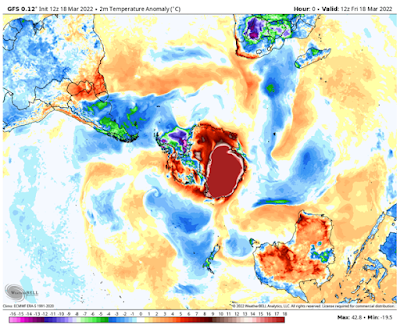
A Hot Topic                                                #215    By Hank Silverberg War is raging in Europe,  the pandemic is still hanging over our heads as more variants  show up, and hostile confrontational politics continue to dominate the headlines. But the biggest threat to mankind may once again have provided strong evidence of impending  worldwide disaster, and it is pretty much being ignored.  The coldest place on Earth, Vostok on the ice shelf in eastern Antarctica, is 50 to 90 degrees above normal right now, warmer than it's ever been before. The sudden rise has scientists who study such things a bit flabbergasted.  It's not exactly balmy, but a heat wave has raised temperatures in Vostok sheet UP to zero. This time of year, it usually averages about -63 degrees Fahrenheit.  Zero is the warmest it's ever b...
Image
Troublemakers                                  #214 by Hank Silverberg Americans have been focused the last few weeks on what is happening in Ukraine and the impact the Russian invasion could have on the United States. That includes everything from gas prices at the pump to domestic politics to the potential for World War III. The Russia-Ukraine war could upset the balance of power in Europe and the world, and definitely IS something to worry about well beyond the price of gas.   The instability there has also brought out the world's troublemakers and reminded us all again how complicated international politics can get.   China has been walking a fine line. The Chinese have supported Russia with words while being careful not to get too involved because of the potential economic impact on them. Disputes between Russia and the West usually end up helping China in the long run.  U....
Image
Truth Dies In War    by Hank Silverberg Call it the fog of war. But it's clear from history that the first casualty of any war is truth.  Saddam Hussein never did have weapons of mass destruction, but the U.S. government used that theme as a major reason for taking down Hussein in the first Gulf War in 1991. Most of the media fed on that narrative until our troops actually got into Iraq and couldn't find any WMD's.   (USS Turner Joy is now a museum in Seattle Courtesy of museumships.us) In August 1964, an alleged attack of the USS Turner Joy off the coast of Vietnam, supposedly the second attack on the U.S. Navy. That prompted the Gulf of Tonkin Resolution in Congress and the first of many deployments of U.S. troops to South Vietnam. The resulting10 year war killed more than 58,000 Americans and over 1.4 million Vietnamese, both military and civilians, and thousands of others in neighboring countries.  We know now that attack never took place....
Image
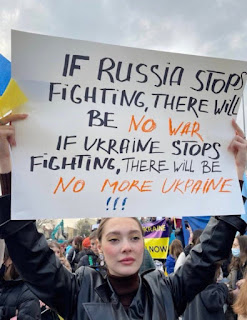
War In Europe  By Hank Silverberg War in Europe. I have heard many people express total surprise about Russia's invasion of Ukraine   (This sign says it all)  this week. Europe has mostly been a peaceful place for decades. After all, the majority of people alive on the planet do not remember the barbarity of World War Two and its 70 million dead.   Yes, there was the civil war in Bosnia and the ethnic cleansing in Serbia that killed hundreds of thousands after the breakup of Yugoslavia in 1992-1995. There were small uprisings like the Prague Spring in 1956 that produced some violence. But Europe has had 80 years of relative peace, and for Europe that, frankly, is historically unusual.  If you look at the list below you will see that in the last 500 years, the continent seems to have been at war every 30 years or so. The wars were mostly about defining borders, ethnic or religious tensions, or one man's quest for empire.  All of those are promptin...